

Probabilistic Structure of the Galton Board
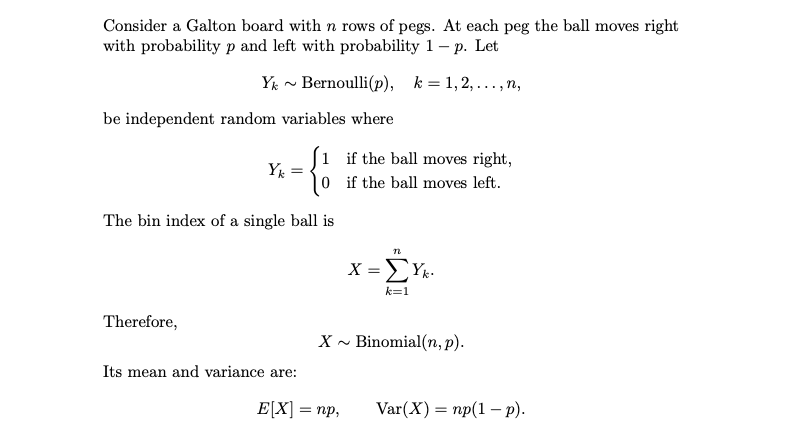
The Galton board (or quincunx) is a mechanical device that provides a physical illustration of fundamental ideas in probability theory. A ball falls through a triangular array of pegs, and at each peg it is deflected either to the left or to the right. Under the natural assumption that each deflection is independent and occurs with fixed probability, the motion of a single ball can be modelled as a sequence of independent Bernoulli trials.
The final horizontal position (bin index) of the ball is therefore the sum of these Bernoulli random variables and follows a binomial distribution. When the number of rows of pegs is moderately large, the binomial distribution is well approximated by a normal distribution, explaining the characteristic bell-shaped curve observed in the device.
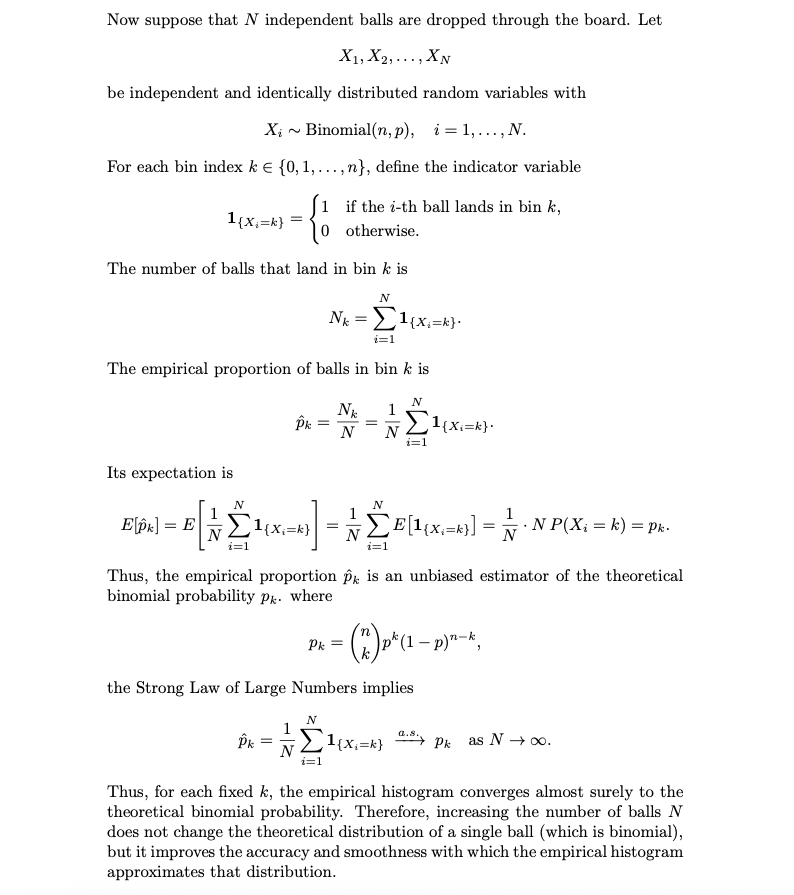
When many balls are dropped independently, the empirical histogram of landing positions converges to the underlying binomial probabilities by the Law of Large Numbers. Thus, the Galton board illustrates several central concepts of probability theory: Bernoulli trials, the binomial distribution, the normal approximation, and convergence of empirical frequencies.
Model of a Single Ball
Normal Approximation (De Moivre–Laplace)

Many Balls: Empirical Distribution
CLT Over Balls
Conceptual Summary
There are three probabilistic levels in the Galton board:
1. Peg level: Bernoulli random variables.
2. Ball level: Sum of Bernoulli variables ⇒ Binomial distribution.
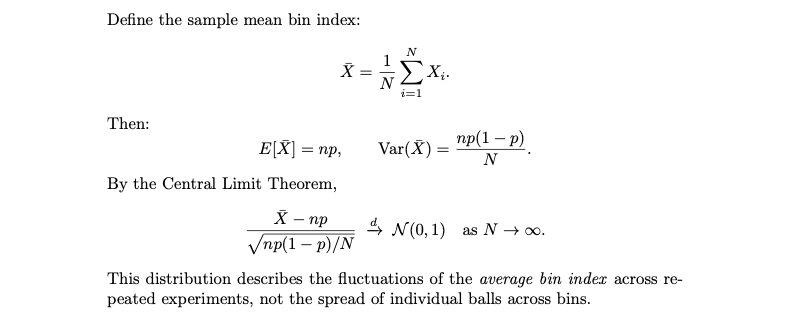
3. Experiment level: Average over many balls ⇒ Normal distribution (CLT).
The bell-shaped histogram of a Galton board is explained primarily by the binomial distribution of a single ball, while a large number of balls ensures a
smooth empirical approximation to this distribution.