

AMR Forecast
AMR Forecast: Antimicrobial Resistance Forecasting Tool
AMR Forecast is a specialised educational iOS application designed for medical students, clinicians and researchers to explore antimicrobial resistance (AMR) trends and estimate when resistance levels may reach selected clinical thresholds.
1. How the Data and Forecasts are Generated
To provide consistent and reproducible forecasts, AMR Forecast uses validated monthly phenotypic antimicrobial resistance surveillance data from the UK Health Security Agency (UKHSA) for England. The iOS application runs a batch forecasting workflow, analysing all supported antibiotics for the selected pathogen and returning a consolidated forecast summary.
Official Surveillance Data: Monthly phenotypic antimicrobial resistance data are obtained from the UKHSA public surveillance platform for validated pathogen–antibiotic combinations. Each time series represents the proportion of tested isolates reported as resistant over time.
Batch Forecasting Pipeline: When a pathogen is selected, the forecasting engine automatically analyses each supported antibiotic associated with that pathogen. Every pathogen–antibiotic time series is processed independently using the same forecasting framework, allowing the results to be presented together in a single summary table.
Mathematical Forecasting Framework: The model first converts the observed resistance proportion into resistance odds. This allows resistance values, which are naturally bounded between 0% and 100%, to be analysed more appropriately as a continuous trend over time. The natural logarithm of the resistance odds is then modelled against time using linear regression.
Time-Aware Trend Estimation: Ordinary Least Squares regression is applied using the actual surveillance dates converted into elapsed years. This preserves the timing of the monthly observations and estimates the underlying direction and rate of change in antimicrobial resistance.
Threshold-Crossing Forecast: For a selected resistance threshold, the model estimates when the fitted resistance trend is expected to reach that threshold. For suitable increasing resistance trends, this estimated crossing point is converted into a predicted calendar date.
Remaining Time Estimate: The application calculates the time between the day the batch forecast is run and the predicted threshold-crossing date. The result is presented in years and months where appropriate, providing an accessible estimate of the remaining time before the selected resistance threshold is predicted to be reached.
Forecast Suitability Assessment: Each pathogen–antibiotic time series is evaluated before a future crossing date is reported. The forecasting pipeline considers data quality, observation span, trend direction and model fit. Weak, declining, highly variable or insufficiently supported trends are not presented as reliable future threshold-crossing forecasts.
Forecast Uncertainty: Residual bootstrap resampling is used to evaluate uncertainty in the fitted resistance trajectory. Repeated bootstrap forecasts generate a distribution of estimated threshold-crossing dates, from which the lower and upper bounds of the reported 95% crossing-date interval are derived.
The iOS application presents the final batch forecast summaries rather than exposing the full regression diagnostics and analytical outputs used during model development and validation.
2. What AMR Forecast Displays
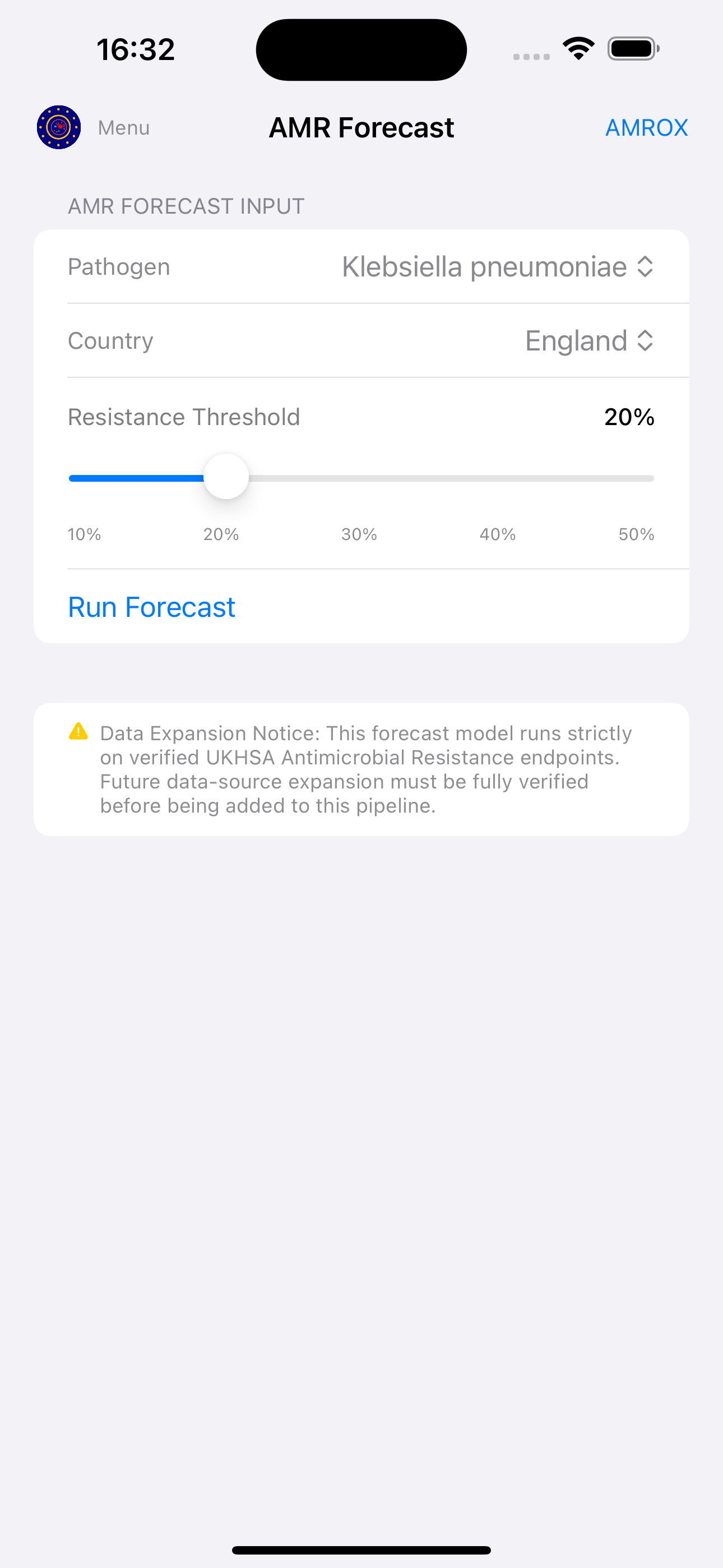
The AMR Forecast iOS app provides a streamlined interface for running batch forecasts and reviewing summary results generated from official UKHSA antimicrobial resistance surveillance data.
Batch AMR Forecasting: Select a pathogen to run forecasts across its supported antibiotics. The application processes the available pathogen–antibiotic combinations and presents the results in a consolidated summary table.
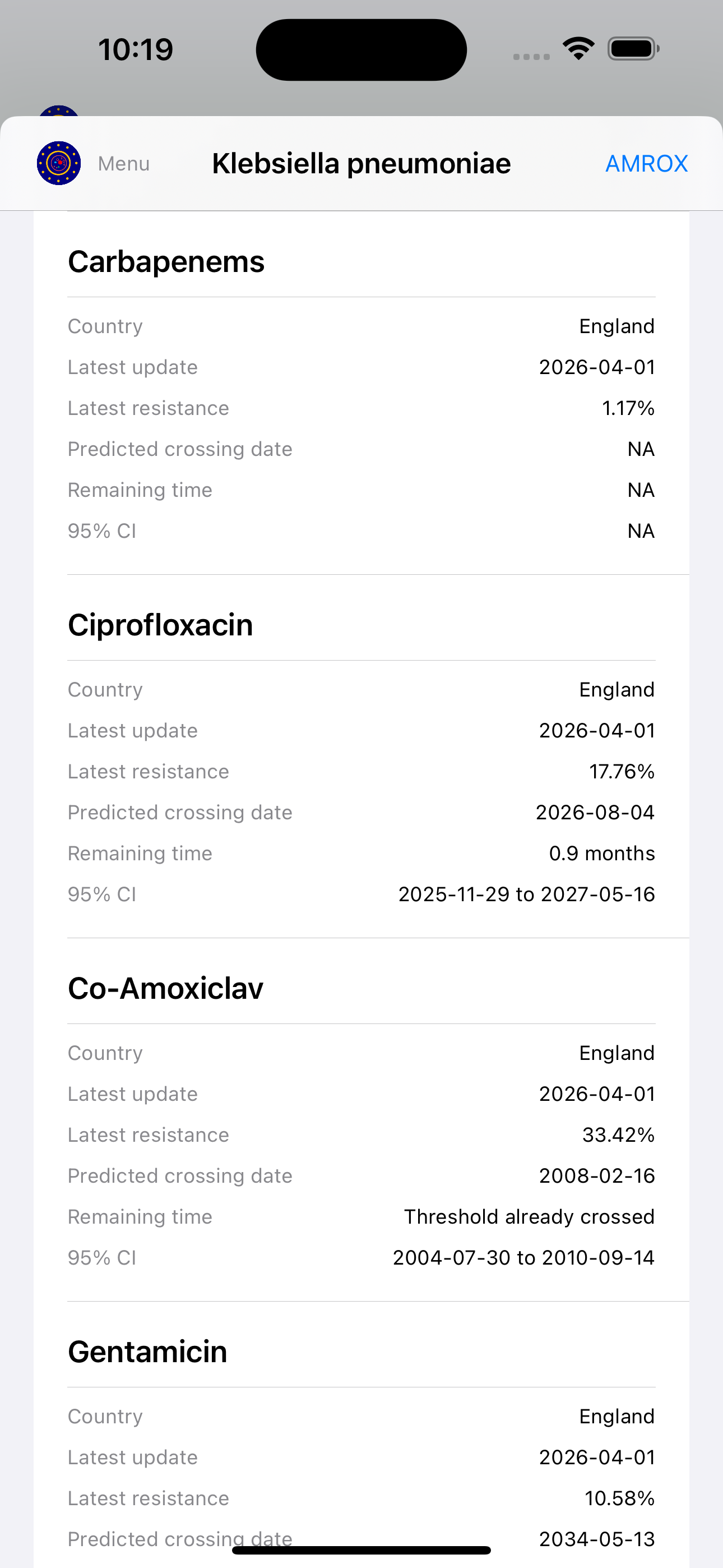
Forecast Summary Table: Review the batch forecast results for each supported antibiotic, providing a concise overview of current resistance levels and predicted threshold-crossing outcomes.
Country: View the country associated with the surveillance data used for the forecast.
Latest Update: View the most recent surveillance date available for each pathogen–antibiotic combination.
Latest Resistance: Review the latest observed resistance percentage reported in the surveillance dataset.
Predicted Threshold-Crossing Date: For suitable resistance trends, view the estimated date when antimicrobial resistance is predicted to reach the selected resistance threshold.
Remaining Time Estimate: View the estimated time from the day the forecast is generated until the predicted threshold-crossing date, presented in years and months where appropriate.
95% Crossing-Date Interval: Review the estimated 95% uncertainty interval around the predicted threshold-crossing date, providing additional context for interpretation of the forecast.
3. Screenshots from AMR Forecast
Screenshots from AMR Forecast demonstrate pathogen and antibiotic selection, resistance surveillance summaries, forecast suitability assessment, predicted threshold-crossing dates, remaining-time estimates and 95% crossing-date intervals.
📈 AMR Forecast Web Applet Notice
Note to Visitors: This public web preview provides a demonstration of the AMR Forecast workflow using official phenotypic antimicrobial resistance surveillance data from the UK Health Security Agency for England. The applet is designed to show batch forecast summaries for supported pathogen–antibiotic combinations.
When a pathogen is selected, AMR Forecast analyses the supported antibiotics for that pathogen and displays a summary table including country, latest surveillance update, latest observed resistance, predicted threshold-crossing date, remaining time, and the 95% crossing-date interval where a forecast is suitable.
Forecasts are generated using a transparent mathematical framework based on resistance proportions, log-odds trend modelling, time-aware linear regression, threshold-crossing estimation, and bootstrap-based uncertainty assessment. Weak, declining, highly variable, or insufficiently supported trends are not presented as reliable future threshold-crossing forecasts.
Disclaimer: AMR Forecast and this applet are intended solely for education, research, and public health surveillance support. Forecast outputs are informational and should not be used as a substitute for professional clinical judgement, diagnostic testing, antimicrobial stewardship decisions, medical advice, or official public health guidance. The developers assume no liability for any decisions made based on this information.